See the rules beneath the rules
Learn to recognise the unspoken expectations that shape what people really do, especially when nobody is watching.
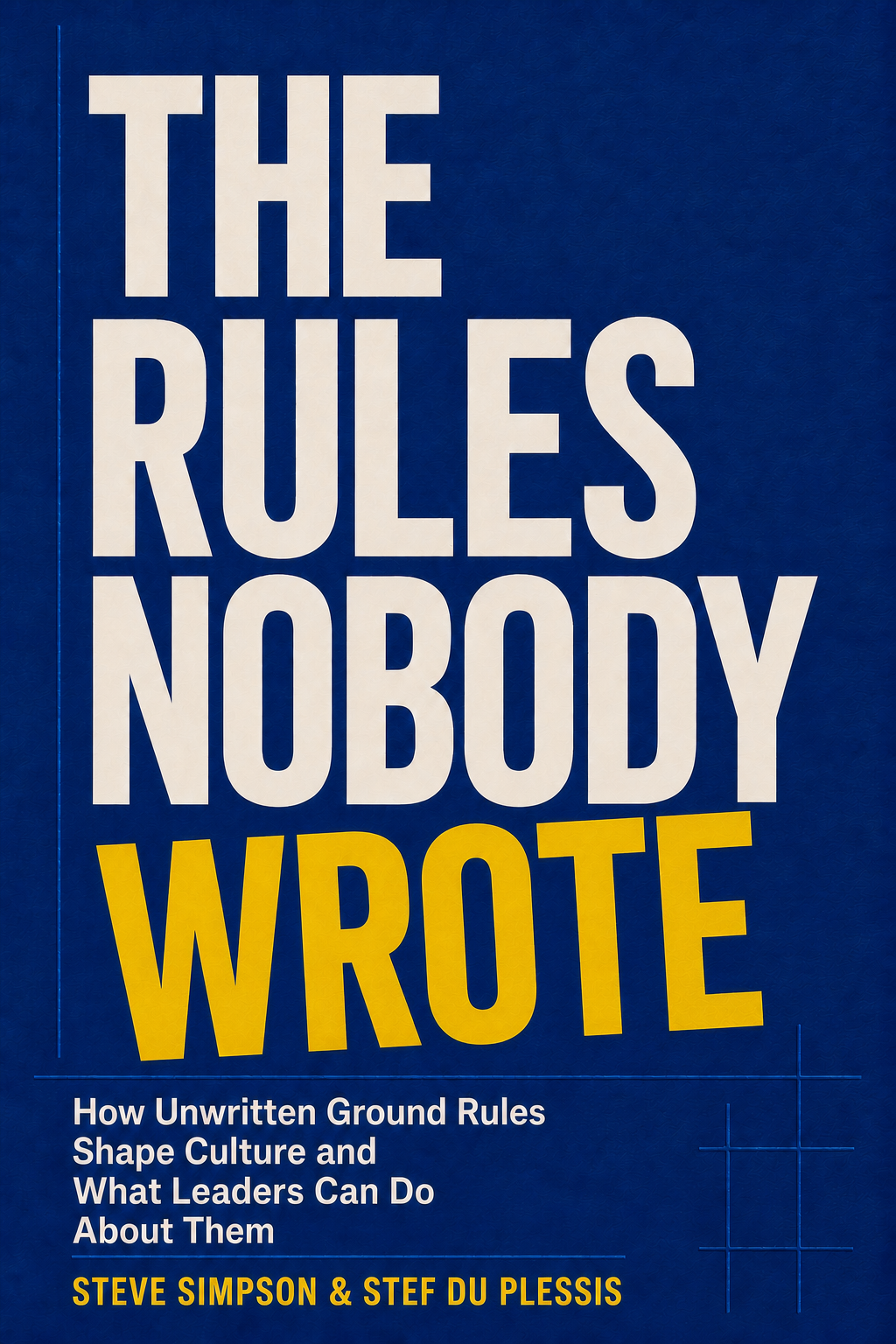
A new book for leaders who shape culture
Every workplace has unwritten ground rules. They decide who speaks honestly, which standards genuinely matter and what leaders are allowed to ignore. This book shows you how to see them and what to do next.
Culture is often described in polished statements. But it is experienced in small moments: what happens when someone makes a mistake, challenges a decision, misses a target or tells an uncomfortable truth.
Through compelling stories from boardrooms, mine sites, hotels, warehouses and one of the world’s most exacting automotive companies, Steve Simpson and Stef du Plessis reveal how invisible rules take hold and how leaders can change them.
From the book
More specifically, it is about a concept we call Unwritten Ground Rules, or UGRs®: the unspoken, undocumented, almost never openly discussed rules that genuinely govern how people behave in any group of human beings, from a waiting room to a boardroom to a five-person team that has been together for six months.
In most cases, nobody designs them. Nobody votes on them. And yet they are, in every workplace either of us has ever encountered, considerably more powerful than anything printed in a values statement, a staff handbook, or a mission poster mounted somewhere near reception.
Learn to recognise the unspoken expectations that shape what people really do, especially when nobody is watching.
Discover how everyday leadership moments reinforce, challenge or quietly overturn the culture already in the room.
Use a practical way of seeing culture that helps leaders begin changing it without another abstract transformation programme.
“Because when the values on the wall and the rules in the room disagree, the room always wins.”
THE CENTRAL IDEA BEHIND UNWRITTEN GROUND RULES
The blind spot that comes with authority
From the book
Here is the uncomfortable truth: those with the most authority to change a culture are often least able to see its real shape, because their presence changes what others will say and do.
Leadership does not automatically confer clear sight. In some very real ways, it does the opposite: it changes the room the moment a leader enters it. What is happening in your meetings the moment you leave them? And who, right now, without your realising it, have you already decided does not need to know?
How cultures actually change
From the book
Culture actually changes through hundreds of small, honest, mildly uncomfortable admissions that gradually make honesty less dangerous. Sustainable change asks for repeated moments of manageable discomfort.
You need both the system and the courage. A standing agenda item without honest moments beneath it is theatre. Individual courage without leadership support eventually burns out the people brave enough to show it.

Creator of the UGRs concept, international speaker, author and workplace culture specialist.
Visit Steve’s website ↗
World-renowned speaker and culture transformation expert who helps leaders turn insight into action.
Visit Stef’s website ↗A final question for every leader
For most workplaces, the honest answer is luck. Leaders inherit a culture and spend their careers reacting to it, grateful when it is good, resigned when it is not, rarely asking whether either outcome was inevitable.
It was not. A culture formed by accident can be reformed on purpose. It is neither quick nor comfortable, but it is possible; I have spent much of my working life watching it happen in rooms like yours.
Where is the rule that says it can’t be yours?
Start seeing culture differently
Order The Rules Nobody Wrote and discover a clearer, more practical way to understand the culture your leadership creates every day.